Shared Copper, Shared Fate: A Month of Powerline Networking on a Victorian Ring Final
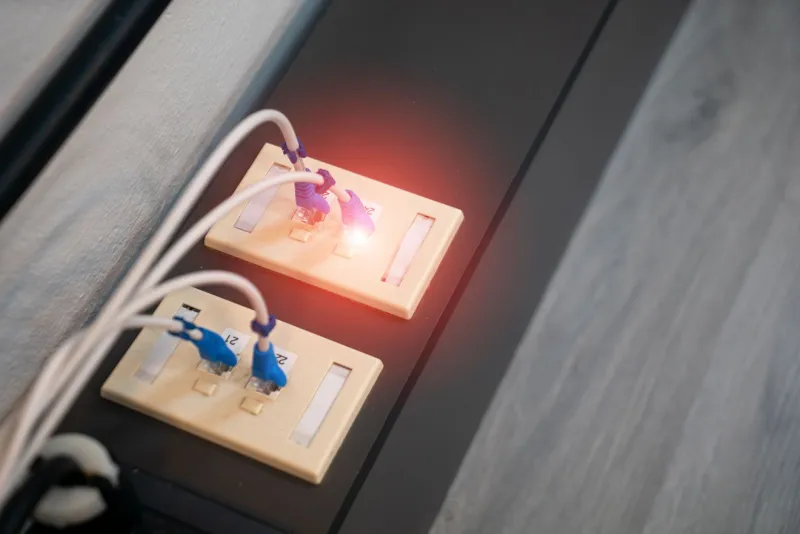
Powerline networking has a simple sales pitch: the cable is already there, so use it. Plug one adapter into a socket near the router, another near the device, pair them, and treat the mains as Ethernet. In a Victorian terrace, that pitch meets a more complicated reality. The wiring was never designed as a communications medium. It is a set of ring final circuits, spurs, junctions and consumer-unit devices, all carrying a mixture of 50 Hz power and whatever high-frequency noise the appliances decide to inject.
CavLab spent four weeks in October and early November 2026 instrumenting powerline links across three circuits in a three-storey Victorian terrace. The aim was not to crown a winning adapter, but to understand the medium. Throughput, latency, packet loss and standby draw were recorded alongside appliance activity. The results are site-specific, but the pattern is not: powerline performance is dominated by topology and noise, not by the number printed on the box.
The topology underneath the socket
The house has a ground-floor ring final, a first-floor ring final and a kitchen radial serving white goods. The consumer unit is at the rear, with the boiler on its own supply. The wiring is a mixture of original and later additions, including a spur that feeds a study socket and a junction box that has clearly seen several decades of enthusiasm.
A ring final is not a clean bus. It is a loop with two paths back to the consumer unit, which is good for voltage drop and cable loading but awkward for high-frequency signalling. A powerline adapter launches a differential-mode signal between live and neutral. That signal must cross MCBs, RCBOs, the busbar and any spurs before it reaches the far adapter. Every discontinuity changes the impedance. Every spur acts a little like a stub. The result is not a single channel but a set of paths with different losses and reflections.
That matters because HomePlug AV2 and G.hn adapters are adaptive. They use OFDM, notch out poor subcarriers and renegotiate modulation as the channel changes. When a fridge compressor starts, the adapter does not simply fail. It downshifts. Throughput falls, latency rises and retransmissions increase. To a user, that can look like a mystery slowdown. To the mains, it is just another appliance switching on.
What the adapters measured
Three pairs of HomePlug AV2 1200 adapters were used, with a G.hn pair as a cross-check. Each link was sampled for 24 hours at a time using iperf3 over TCP and UDP, with one-minute ping runs and a plug-in power meter for standby draw. Adapters were plugged directly into wall sockets, not extension leads or surge protectors.
| Link | Median TCP down/up | 95th percentile latency | UDP loss |
|---|---|---|---|
| Same ring final, adjacent rooms | 210/180 Mbps | 7 ms | 0.03% |
| Ground floor to first floor, cross-circuit | 94/76 Mbps | 14 ms | 0.21% |
| Ring final to kitchen radial spur | 48/39 Mbps | 22 ms | 0.65% |
The headline is unsurprising to anyone who has tried powerline in an old house. Same-ring links were usable for general browsing, file transfers and video streaming. Cross-circuit links worked, but with a clear throughput penalty. The spur link was the weakest: still functional for a smart TV, but not for a NAS backup or a video call from the same room.
Latency was more revealing than throughput. Baseline ping times were low, often under 10 ms, but the 95th percentile told a different story. On the spur link, one in twenty pings exceeded 22 ms, and occasional spikes reached 80 to 120 ms. That is enough to make a video call feel brittle even when the speed test looks acceptable.
When the fridge becomes a packet source
Correlating packet loss with appliance activity was the most useful part of the exercise. A current clamp on the boiler supply and a vibration sensor on the fridge gave rough event markers. The fridge compressor produced the clearest pattern: during start-up and early running, throughput on the kitchen spur fell by 35 to 60%, and UDP loss rose from a baseline of 0.6% to as much as 2.5%.
The boiler pump produced shorter, sharper latency spikes. A dimmer switch in the living room, set to low brightness, raised the noise floor across the ground-floor ring final and forced the adapters to renegotiate. None of these appliances is unusual. That is the point. A British home is full of switched-mode power supplies, motors and thyristor controllers. Powerline adapters live in that environment, and they cope by giving up capacity.
This is not an argument that powerline is useless. It is an argument that powerline is a shared medium with a variable noise floor. The adapter's link-rate LEDs are a poor guide to what is happening. A link that reports 400 Mbps may deliver 90 Mbps after retransmissions. A link that reports 200 Mbps may deliver a steady 150 Mbps because the channel is clean. The only useful measurement is the one taken at the application layer, over time.
The standing cost
Standby draw was modest but not zero. The AV2 adapters consumed between 2.1 and 3.4 W each when linked but idle. A pair therefore costs roughly 5 W continuously, or about 44 kWh a year. At a typical 2026 standard variable rate of around 30p/kWh, that is roughly £13 annually. It is not a reason to reject powerline, but it is a reason to avoid leaving a pair powered for a link that is used once a week. Passthrough sockets help with convenience, not with consumption.
When the mains is the better backhaul
Powerline still has a legitimate role. In a solid-walled Victorian terrace, Wi-Fi has to fight brick, foil-backed plasterboard and the occasional chimney breast. Ethernet is better, but pulling cable through lath and plaster is not always practical, especially in a listed building or a rental. A same-ring powerline link can be a reasonable backhaul for a mesh node, a smart TV or a desktop that does not need low latency. It is often more stable than a weak Wi-Fi bridge through two walls.
The guidance is straightforward. Try to keep both adapters on the same ring final. Avoid spurs if possible. Plug directly into wall sockets. Keep adapters away from surge protectors, which can filter the very signal they rely on. Test with real traffic over several days, not a single speed test. If latency matters, measure latency under load and during appliance cycles. If the link crosses circuits, expect a penalty. If it crosses a spur, expect a larger one.
Powerline does not turn the ring main into a network. It turns the ring main into a shared copper medium that sometimes behaves like one. In a Victorian terrace, that is enough for some jobs and a disappointment for others. The useful question is not whether powerline is faster than Wi-Fi in principle, but whether this particular set of circuits, appliances and walls can support the job at hand. The answer is measurable, and it is rarely the one on the packaging.