Thirteen Amps of Caution: Taking Apart the British Plug to See What BS 1363 Still Gets Right
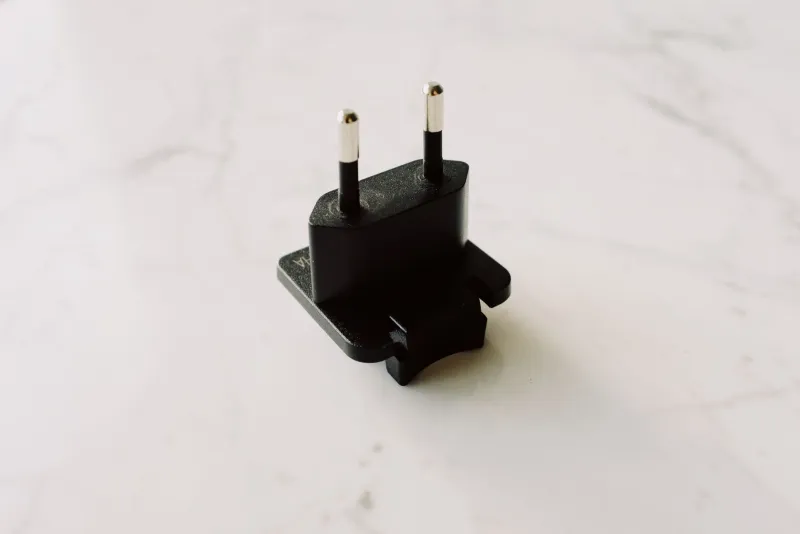
There are few pieces of domestic electrical hardware that a member of the public can hold, dismantle with a single screwdriver, and find nothing to sneer at. The British plug is one of them. It is over-engineered by the standards of the European Schuko or the American NEMA connector, it is heavier, and it costs more to make. It is also, on almost every measure that matters, safer.
What follows is a teardown in two senses. We took a knife to a moulded plug top and a screwdriver to a rewirable one, and we also took apart the reasoning behind BS 1363 — the design decisions baked into the standard, and whether those decisions still hold up in a 2026 home containing an EV charger, a heat pump and a drawer full of USB-C power supplies.
A standard shaped by scarcity
BS 1363 emerged from post-war reconstruction work at the British Standards Institution, published in 1947 and revised repeatedly since. Its most distinctive feature — the fuse inside the plug — is usually explained as a consequence of the ring final circuit. That is only half the story, and the half that gets repeated in electricians' forums.
The ring circuit was adopted partly to save copper at a time when the metal was scarce and expensive. The consequence was that a single 32A protective device could sit upstream of a great many socket outlets. Without a fuse local to the appliance, a 0.75mm² lamp flex would be depending on a 32A breaker to clear a fault. It would not clear it. The flex would simply heat until something gave way.
So the plug became a protective device in its own right: 3A for lighting and small electronics, 13A for heavier loads, with a handful of intermediate ratings. The important point, routinely misunderstood even by people who should know better, is that the fuse protects the cord and the plug — not the appliance.
Anatomy of a plug top
Remove the lid and the bill of materials is short. Three brass pins, a fuse carrier, a cord grip, and a body moulded in urea-formaldehyde or, more commonly now, a filled thermoplastic.
The geometry does most of the safety work. The earth pin is longer and thicker than line and neutral, so it makes first and breaks last; it also displaces the shutters in the socket, which is why a two-pin Europlug cannot be inserted without deliberate effort. Line and neutral pins are sleeved for most of their length, a requirement that hardened during the 1980s revisions after concern about fingers and partially withdrawn plugs. The pins are chamfered at the tip. The cord grip is a proper clamp rather than a gesture.
None of this is glamorous, and none of it is accidental. It is the reason a UK socket is difficult to misuse and even harder to misuse accidentally.
The trade-offs nobody prints on the box
The plug's safety margin is bought with real costs. Its bulk makes it awkward behind furniture and impossible to shrink onto a slim laptop supply. Its price is a few pounds for a decent rewirable unit and rather more for a moulded one. And the 13A rating is not the continuous rating that many people assume.
A 13A fuse will carry 13A indefinitely in a laboratory at 20°C. In a warm cupboard, behind a sofa, with a plug top that has been running a 10A load for six hours, the thermal picture is less comfortable. IET guidance has long encouraged designers to treat the 13A plug as suitable for roughly 10A continuous, and the failures seen in the field — discoloured pins, brittle plug tops, scorched socket outlets — cluster precisely around that gap between the label and the duty cycle.
That mattered less when the heaviest domestic load was a 3kW kettle running for four minutes. It matters considerably more now.
The regime that keeps it honest
BS 1363 is not a one-off approval. Plugs and sockets are tested for temperature rise at rated current, for mechanical endurance across thousands of insertions and withdrawals, for resistance to impact and heat, for the security of the cord grip, and for the force needed to pull a pin out of its body. Socket shutters are assessed for the effort required to open them and for their resistance to being defeated by a single probe. The standard also constrains dimensions tightly — pin spacing, pin length, the profile of the earth pin — because interoperability between makes is the entire point.
The weakness in any such regime is not the specification but the enforcement. A plug bearing a BS 1363 mark and no meaningful traceability is a common sight on online marketplaces, and no test house can inspect what never crosses its bench. The standard is strong; the supply chain around it is not uniformly so.
Is thirteen amps still the right answer?
Here the argument becomes genuinely awkward. The plug was designed for a world of resistive heaters and induction motors, not for 7kW vehicle charging, inverter-driven heat pumps, or a house in which the average socket is expected to deliver 65W of USB-C power in perpetuity.
Charging an EV from a 13A socket is the obvious stress case. Ten amps for eight or ten hours is a duty cycle the plug was never really intended to face, and the advice to use a dedicated charge point rather than a three-pin socket is sound rather than merely commercial. Heat pumps are less dramatic but more widespread: a 2kW outdoor unit on its own circuit is unremarkable, but the trend towards larger units and immersion backup heaters pushes closer to the limit. Meanwhile the slow spread of USB-C Power Delivery means the 13A socket increasingly feeds a switched-mode supply drawing almost nothing, which makes the fuse look like a relic.
The counter-argument is that the plug has absorbed two generations of change without a systemic failure, and that its conservatism is the point. A standard slightly oversized for its era is cheaper than a standard slightly undersized.
Having taken one apart, our view is that the fuse remains the feature. What needs revisiting is not the plug's geometry but the honest labelling of continuous duty, the traceability of imported products, and the guidance given to households about what a 13A socket can genuinely sustain for eight hours rather than four minutes.
The plug has earned its reputation. It has not earned the right to be described as future-proof.