Accidental Paths: Four Weeks Spent Chasing Earth Leakage Around a Victorian Terrace
There is a particular kind of autumn evening in a Victorian terrace when the lights go out for no reason at all. No burning smell, no bang, no obvious culprit — just a residual current device in the hallway cupboard that has decided, at 19:40, that something is wrong. Reset it and it holds for an hour, or a day, or a fortnight. The uncertainty is the difficult part.
What follows is an account of four weeks spent converting that uncertainty into numbers, using a leakage clamp meter and a certain amount of patience, across nine final circuits in a house built in 1898 and rewired in stages between 1974 and 2019.
The arithmetic before the annoyance
An RCD is not an intelligent device. It compares the current leaving through the line conductor with the current returning through the neutral, and it trips on the difference. BS EN 61008-1 requires a 30 mA device to hold at half its rated residual current — 15 mA — and to operate at no more than 30 mA, with most examples tripping somewhere in the low twenties when ramped.
That threshold is not a fault level. It is a total, and it is shared. Every Class I appliance with a switch-mode supply contains EMC filtering, usually a pair of Y-rated capacitors bridging line and neutral to earth, and those capacitors pass a small 50 Hz current continuously by design. A stationary Class I appliance may legitimately exhibit up to 3.5 mA of protective conductor current under EN 60335-1. A dozen permanently energised devices — fridge, boiler, router, extractor, microwave, television, three chargers — can therefore account for a third of the trip threshold with nothing whatsoever wrong with any of them.
Against that background, the correct question is not "which appliance is faulty?" but "what is the running total, and which part of it is changing?"
Instrument first, opinion second
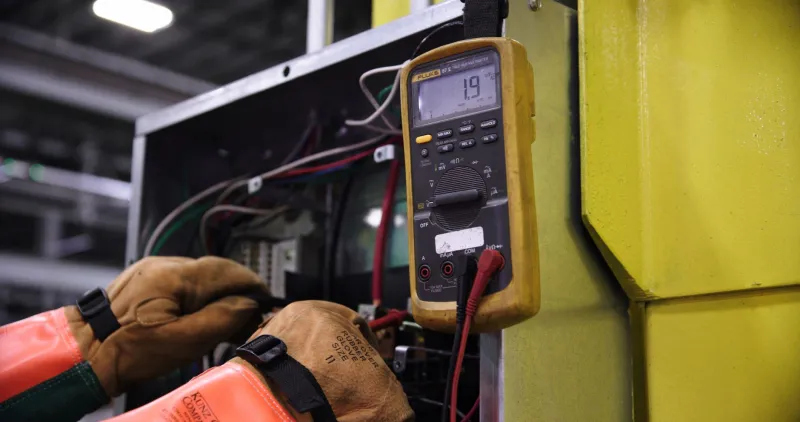
A conventional multimeter cannot help here; the currents are too small and the resistance of the earth path too low. The tool for the job is a true-RMS leakage clamp meter with resolution down to 10 µA, capable of being zeroed, and — crucially — small enough in the jaw to close around a single circuit's line and neutral conductors together at the consumer unit.
Clamped that way, the meter reads the residual current for that circuit alone: the difference between what went out and what came back, which is the current taking an accidental path through the protective conductor, the fabric of the building, or a person.
Two practical cautions. First, readings drift if the jaw is not cented on the conductors and if neighbouring cables are carrying load; clamp around a circuit known to be clean as a sanity check before trusting a 0.4 mA figure. Second, measure the house in its normal condition. Leakage from filter capacitors is largely independent of load, but leakage from a damp element or a soiled appliance is not, and a house measured with everything switched off will flatter itself.
What the nine circuits said
Measurements were taken on three October evenings, with a fourth session during a wet week, and logged against relative humidity in the hall.
| Circuit | Standing (loads off) | Typical evening | Wet week |
|---|---|---|---|
| Kitchen ring final | 0.8 mA | 6.2 mA | 6.4 mA |
| Utility and boiler spur | 0.3 mA | 2.4 mA | 2.6 mA |
| Downstairs sockets | 0.9 mA | 3.1 mA | 3.4 mA |
| Upstairs sockets | 0.6 mA | 2.8 mA | 2.9 mA |
| Lighting, ground floor | 0.2 mA | 0.4 mA | 0.5 mA |
| Lighting, first floor | 0.1 mA | 0.3 mA | 0.3 mA |
| Immersion heater | 0.0 mA | 1.6 mA | 1.6 mA |
| Outside socket and garden lighting | 0.4 mA | 4.9 mA | 9.8 mA |
| Cooker (no socket) | 0.0 mA | 0.0 mA | 0.0 mA |
The totals were 3.3 mA at rest and 21.7 mA on an ordinary evening. A ramp test on the RCD then produced operation at 23 mA. In other words, the device was doing precisely what it was built to do, with roughly a milliamp and a half of headroom between a normal Tuesday and a darkened house. No single appliance was misbehaving enough to explain it.
Three readings worth following up
The first was the fridge-freezer, an inverter-compressor model of 2018 vintage, contributing 1.9 mA whenever the compressor was running. That is a filter, not a fault, and short of replacement there is nothing to fix.
The second was the outside socket: a double, west-facing, installed in 2016 with a gasket that had since perished. Its leakage tracked the weather almost linearly — 0.4 mA in dry air, 9.8 mA after four days of rain. An insulation resistance test at 500 V DC returned 180 MΩ on a dry afternoon and 0.6 MΩ when damp, which is the signature of water reaching a terminal block rather than a cable damaged by a nail. This was a genuine deterioration, and the only component in the house that justified immediate attention.
The third was the immersion element, which drew an extra 1.6 mA whenever it was energised and whose insulation resistance fell to 1.1 MΩ when warm. Not dangerous, not yet, but a heater element that is failing hygroscopically tends to get worse, and it sits on the same device as everything else.
A borrowed neutral on the first-floor lighting — the classic candidate in a house extended twice — was ruled out early by isolating circuits one at a time and confirming that no residual current appeared on a circuit that was switched off.
The limits of a clamp
The meter gives a total, not a decomposition. A Type AC RCD responds to sinusoidal alternating residual current and can be blinded by smooth direct current of a few milliamps; a Type A device also responds to pulsating DC. Where an EV charge point or a transformerless PV inverter is installed, the relevant standard already demands additional protection — 6 mA DC detection for charge points — and a Type AC device upstream of such equipment is the wrong component regardless of what the clamp says. Harmonic content also inflates the reading in a way that does not necessarily translate into tripping.
None of this replaces safe isolation and insulation resistance testing, and opening a consumer unit is not a task for the curious amateur, however good the instrument.
What was actually done
The outside socket was replaced and its enclosure resealed. The immersion element was swapped at the same time. The more useful change, though, was structural: splitting the circuits across two RCDs — or, better, individual RCBOs — so that one deterioration takes out one way rather than the whole house. A Type A device was specified for the replacement, and the freezer was given a dedicated, clearly labelled circuit so that its perfectly normal 1.9 mA could be reasoned about separately from everything else.
A log was started, with a column for humidity. Three months in, the pattern is already clear: the house is a milliamp or two leakier in February than in June, and the number that matters is not the thirty, but the distance between a normal evening and it.
The RCD was never faulty. It was adding up, in the dark, on our behalf.