The Garage Dividend: Usable Energy From Three Portable Power Stations After Dark
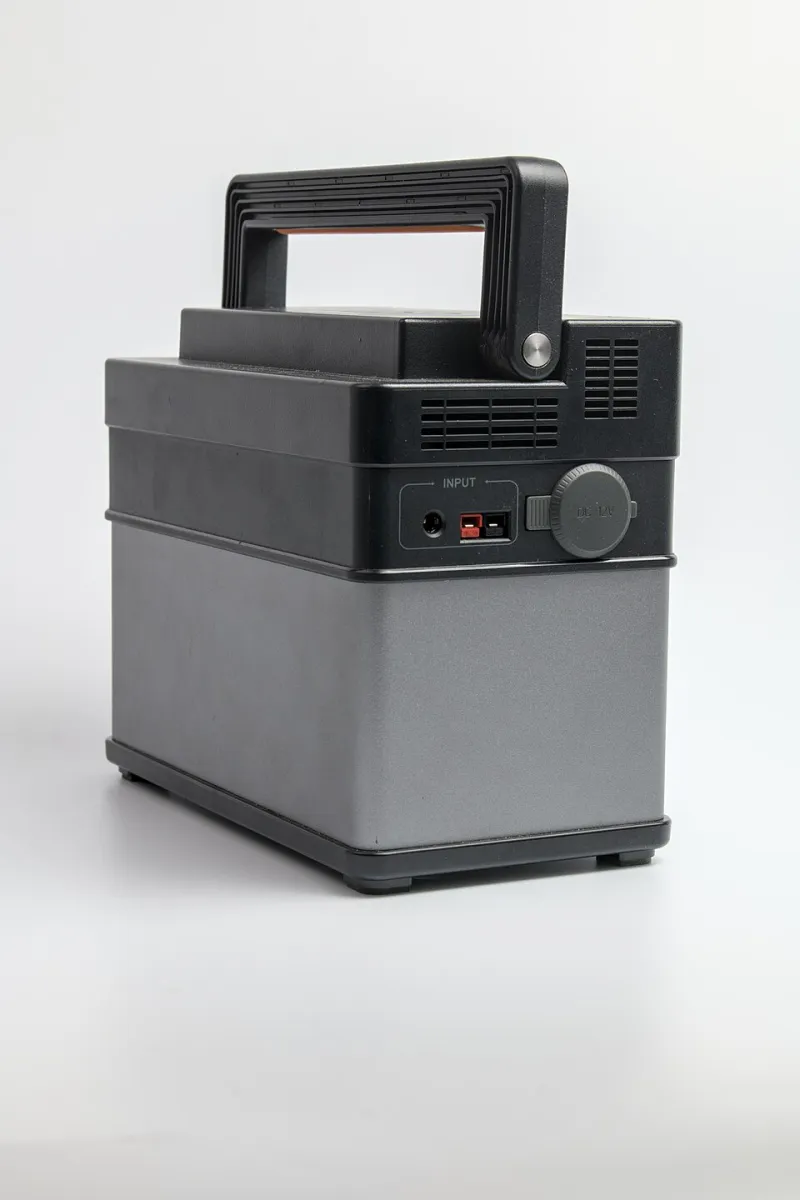
Photo: -stk, CC BY-SA 4.0, via Wikimedia Commons
A portable power station is sold on watt-hours. A power cut is survived on usable energy. Those are not the same number. Over three cold evenings this autumn I ran three units in an unheated garage at 4–6°C, powering a fridge, a broadband router and a gas boiler's circulating pump for a simulated eight-hour outage. The aim was not to repeat the nameplate claims but to measure what the loads actually received, and which loads the units refused.
The test setup
The three units had advertised capacities of 1,024 Wh, 1,536 Wh and 2,048 Wh, all with lithium iron phosphate cells and pure sine-wave inverters. I will call them A, B and C. Each was charged to 100% indoors, then moved to the garage for four hours before testing. A calibrated energy logger sat between the station's AC output and the loads. A separate logger recorded garage temperature and the station's own DC input where available.
The loads were deliberately domestic rather than laboratory resistors: a 230 V fridge with a nominal 80 W compressor, a 12 W router, and a 55 W boiler pump. The fridge cycled at roughly 35% duty. The router ran continuously. The boiler pump ran continuously, but the boiler's control board was also connected, because a pump without a boiler is not a realistic test.
| Unit | Advertised | Usable at 20°C | Usable at 5°C | No-load draw | Transfer time |
|---|---|---|---|---|---|
| A | 1,024 Wh | 880 Wh | 790 Wh | 9 W | 18 ms |
| B | 1,536 Wh | 1,320 Wh | 1,190 Wh | 12 W | 22 ms |
| C | 2,048 Wh | 1,760 Wh | 1,580 Wh | 15 W | 30 ms |
The 20°C figures came from a resistive load test. The 5°C figures came from the same test after cold soaking. The no-load draw is the inverter's own appetite with nothing connected. Transfer time is the gap between mains loss and AC output in emergency power mode, measured with an oscilloscope and a lamp.
What the loads ask for
The fridge was the first surprise. Its 80 W running load is modest, but its compressor start drew close to 400 W for a fraction of a second. Unit A handled it, but its inverter gave an audible step and the logger recorded a brief voltage dip. Unit B coped cleanly. Unit C, despite the largest capacity, refused the first start because its surge limit was set conservatively and the fridge was already cold. A second attempt succeeded. A power station that cannot start a cold fridge is not a power station for a power cut.
The router was easy. Twelve watts for eight hours is 96 Wh, a small fraction of any of these units. The boiler pump was harder in a different way. The pump itself is inductive and the boiler board is sensitive to transfer time. Unit A's 18 ms transfer kept the boiler running. Unit B's 22 ms transfer caused the boiler to lock out once. Unit C's 30 ms transfer caused a lockout on both attempts. The pump would run, but the boiler would not fire. That is the kind of refusal that matters on a cold evening.
The cold arithmetic
Lithium iron phosphate cells lose usable capacity at low temperature, and the battery management system may limit discharge current. The effect is not dramatic at 5°C, but it is measurable. Unit A lost about 10% of its warm usable energy, B about 10% and C about 10%. The bigger loss came from inverter overhead and cycling. A fridge that cycles on and off makes the inverter wake and sleep, and each transition carries a small penalty. The router and pump kept the inverter awake, which is more efficient but also means the no-load draw is always subtracted from the total.
In the mixed-load test, the delivered energy before shutdown was 640 Wh for A, 980 Wh for B and 1,290 Wh for C. Those figures are 20–37% below the warm resistive results. The gap is not a fault. It is the difference between a laboratory load and a dark garage with a cycling compressor and a boiler board.
The dark evening
For an eight-hour outage covering a fridge, a router and a boiler pump, the useful requirement is roughly 1.2 kWh once cycling and overhead are included. Unit A is marginal. Unit B is comfortable. Unit C has the largest nameplate but the slowest transfer and the highest no-load draw, so its advantage is smaller than the label suggests.
The lesson is not that portable power stations are dishonest. It is that the relevant specification is usable energy at the temperature of use, with the surge and transfer requirements of the actual loads. A garage in November is not a showroom. The number on the box is the beginning of the calculation, not the end of it.