The Stopcock's Opinion: Three Smart Water Shutoff Valves and the Pressure They Cannot See
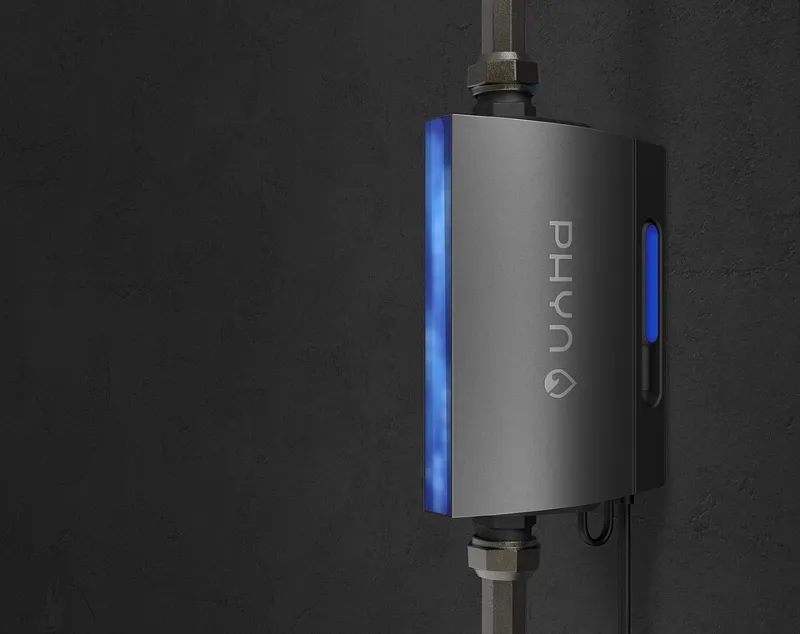
Photo: Jaeroe21, CC BY-SA 4.0, via Wikimedia Commons
A smart water shutoff valve is sold as a simple proposition: it watches the flow, learns what normal looks like, and closes the stopcock when normal stops. The proposition is attractive, particularly in a British house where a hidden leak under a suspended floor can run quietly for weeks. But the incoming mains is not a laboratory constant. It rises and falls with demand, it carries transients from the street, and in terraces and conversions it is often shared with neighbours in ways that no app screen acknowledges.
For four weeks in autumn 2026, CavLab instrumented a 15 mm copper incoming main in a 1930s semi-detached house. Three UK-available smart shutoff valves were tested in turn, each installed downstream of the main stopcock and upstream of the first tee. A calibrated pressure logger recorded at 1 Hz, and a clamp-on ultrasonic flow meter provided an independent flow reference. On the bench, the valves were also presented with controlled drips, cistern refills and sudden opens. The question was not whether they could close a valve. It was what they thought they were closing it for.
The rig and the house
The house has two adult occupants, a combi boiler, a washing machine, a dishwasher and a downstairs cloakroom. Static mains pressure over the test period ranged from 1.8 bar to 4.6 bar, with short transients above 5 bar when the water company shifted demand or a nearby supply was exercised. Flow reference uncertainty was within 0.1 litres per minute at the low rates that matter for leak detection.
The three valves, anonymised here as A, B and C, represent three common architectures: a motorised ball valve with a paddle-style flow sensor, a motorised valve with an inline turbine, and a valve that combines a clamp sensor with a pressure switch. All three are sold in the UK with apps, event histories and some form of automatic shutoff. None was a prototype. All were installed to the manufacturers' instructions, with the relevant water fittings approval checked where it was claimed.
What each valve calls a burst
A dripping tap at 0.2 litres per minute did not trigger any of the three. That is unsurprising and, in one sense, correct: a drip is not a burst. But it is also where the marketing language starts to stretch. A slow leak behind a kitchen unit may never exceed the flow threshold that the valve uses to define an event, and a valve that only reacts to a high flow is a burst protector, not a leak detector.
Valve A used a continuous-flow window of roughly three minutes above 1.5 litres per minute. Valve B required about five minutes above 2 litres per minute. Valve C, the most sensitive in its default mode, reacted above 0.8 litres per minute after ten minutes. On the bench, a simulated burst at 12 litres per minute triggered all three inside their windows. A garden hose left running at 8 litres per minute also triggered all three, which is useful, although the same behaviour could be produced by a long shower or a filling cistern if the household pattern is unusual.
The interesting failures were in the middle ground. A downstairs toilet cistern refilling after a flush drew 4 litres per minute for 90 seconds and was ignored by all three, correctly. A washing machine inlet pulse produced a short spike that valve C briefly logged as an event before cancelling it. Valve B missed a 1.2 litre per minute bench leak entirely because the rate sat below its threshold. None of the apps explained that threshold. The user sees a sensitivity slider labelled from low to high, not a flow rate and a duration.
Pressure transients and the shared main
The pressure logger told a story the apps did not. On several mornings, pressure fell by around 0.7 bar when a neighbouring supply was drawn, then recovered with a small overshoot. Valve A logged a flow event during one of these recoveries, even though the independent meter showed no corresponding volume. The likely cause was a sensor artefact rather than water passing through the pipe. Because the app displayed only 'unusual flow', the event looked like a leak and was not.
This matters in UK housing stock where the supply is not always a private, dedicated line. In terraces, conversions and some rural supplies, pressure behaviour is a shared variable. A valve that infers flow from a pressure switch, or that uses pressure to validate a flow reading, needs to understand the difference between a transient and a leak. The units tested did not expose pressure in their event logs. One did not measure it at all. Another measured it but used it only internally, with no user-visible trace.
A second problem is the valve's own action. When a motorised ball valve closes, it creates a pressure wave upstream. In a house with a combi boiler and a pressurised heating circuit, that is usually manageable. On a shared main, it can be audible in another property. The valves have no way to report this, and the apps have no field for 'pressure transient generated at closure'. The installation is treated as a plumbing accessory, not as a control system with dynamic behaviour.
Apps, thresholds and the insurance-friendly claim
The phrase 'insurance-friendly' appeared in the marketing for two of the three valves. In practice it meant that some insurers may offer a discount when the device is professionally installed and a certificate is produced. It did not mean that the valve had been tested against a standard for leak detection performance, nor that its automatic shutoff had been independently verified. Water fittings approval, where present, concerns materials and compliance with UK water fittings requirements. It is not a statement about how well the product distinguishes a drip from a burst.
The apps were clean and legible, but they omitted the data needed to judge an event. None showed a flow trace with a time axis beyond a stylised bar. None showed the pressure at the time. Only one allowed the user to export a raw event log, and that log contained no sensor calibration information. The user is asked to trust a decision without being shown the evidence behind it.
A more honest specification
A useful smart shutoff for a British home would show pressure as a first-class measurement, not a hidden input. It would log bidirectional flow, because reverse flow can occur during transients and can confuse a simple turbine. It would expose the actual flow and duration thresholds rather than a vague sensitivity scale. It would distinguish a continuous draw from a repeated pulse, and it would allow a manual bypass that does not require the app to be online.
None of the three valves met that specification fully. Each could close a valve when presented with a large, sustained flow. That is a real function, and it is worth having. But the mains is not a constant, and a stopcock's opinion is only as good as the variables it is allowed to see.