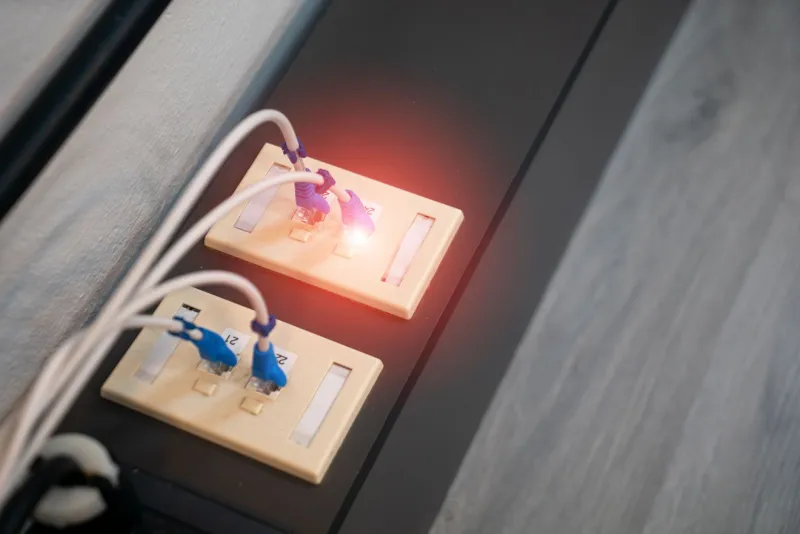
Flicker at the Bottom of the Dial: Twelve LED Lamps and Three Dimmers on Old Wiring
The back bedroom of a 1930s semi-detached house is not an obvious laboratory. It has a single pendant position, a switch drop that has been altered at least twice, and a dimmer plate that was installed in a hurry some years ago. In November 2026, CavLab spent three weekends there and on the bench, testing twelve LED lamps against three dimmers. The question was narrow: when a household replaces halogen lamps with dimmable LEDs on an older British lighting circuit, which of the advertised behaviours survive contact with reality?
The circuit in question
The lighting final circuit itself is not original. It has been rewired at some point, and the consumer unit carries a 6 A MCB rather than a fuse. But the switch drops, back boxes and cable routes retain the habits of an earlier era: shallow metal boxes, short tails, and a landing switch position that shares a neutral with the hallway. This matters because dimmer behaviour is not only a property of the dimmer and the lamp. It is a property of the whole circuit, including the leakage paths and the length of cable between switch and fitting.
We settled on twelve lamps in three groups. The back bedroom had four 6.5 W dimmable GU10 lamps on a leading-edge, neutral-less dimmer rated 5–100 W LED. The landing had four 4 W candle lamps on a trailing-edge dimmer with a neutral connection. The hallway had four 5 W globe lamps on a smart trailing-edge dimmer, also with neutral. All lamps claimed dimmer compatibility. None of the claims named the dimmer we were using.
Three dimmers, three approaches
The neutral-less leading-edge dimmer is the most common retrofit case in the UK, and the most misunderstood. It steals a small current through the lamp to power its own electronics. With a halogen lamp, that leakage is trivial. With an LED driver, it can be enough to keep the driver alive, causing glow, flash or refusal to start. On the bench, the dimmer drew 0.42 mA through a 6.5 W lamp at the off position. That is small, but it is not zero, and it is enough to explain the occasional faint pulse we saw at the back bedroom fitting.
The trailing-edge dimmer with neutral behaved better on paper: it switches the lamp at the zero crossing and is generally kinder to capacitive LED drivers. In practice, it was kinder only when the load was adequate. The smart dimmer added another variable: a minimum-load calibration routine that briefly runs the lamps at full output. That routine is useful, but it is not a substitute for checking the lamp driver's own behaviour at low conduction angles.
Measuring the minimum load
Minimum load is usually quoted as a wattage range. The back bedroom dimmer said 5–100 W LED. The four lamps totalled 26 W at full output, comfortably inside that range. At 10% dim, however, the measured draw fell to 3.8 W. The dimmer had not been told that dimming reduces lamp power; it only knows the load it sees. Below roughly 4 W, the leading-edge dimmer lost stable triggering. The lamps flickered at about 8 Hz, with occasional dropouts.
The landing trailing-edge dimmer held stable down to 2.9 W, but the lamps buzzed audibly at settings below 20%. The hallway smart dimmer held stable to 2.4 W, but only after we changed the lamp batch. The first batch of 5 W globes had a driver that whistled at 100 Hz; the second batch did not. This is the part the marketing copy rarely captures: compatibility is not a property of a wattage alone. It is a property of a driver topology, a dimmer algorithm and a particular production batch.
Flicker, buzz and the photodiode
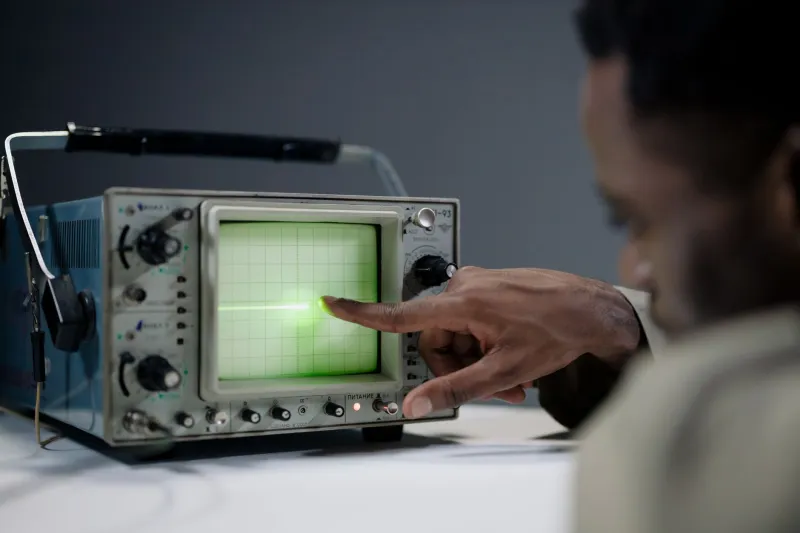
We measured flicker with a photodiode and a simple transimpedance amplifier, sampling at 10 kS/s. At full output, all three groups showed ripple below 5%. At 10% dim, the back bedroom leading-edge group showed a flicker index of 0.19, with a dominant component at 100 Hz and a subharmonic at 8 Hz. The landing group measured 0.07, and the hallway group 0.04. None of these figures is a pass or fail under BS EN 61000-3-3, which addresses voltage fluctuations rather than lamp output, but they are useful comparative data.
Acoustic measurements were cruder but instructive. At 30% dim, the landing lamps produced 38 dBA at one metre in a room with a 29 dBA noise floor. The buzz was concentrated around 100 Hz and 200 Hz, consistent with driver ripple. The back bedroom lamps were quieter but flickered more. The hallway lamps were quiet until the smart dimmer's calibration routine ran, at which point they produced a short chirp. None of this is dangerous. All of it is annoying, and annoyance is a legitimate performance criterion in a bedroom.
What the compatibility list did not say
Each dimmer came with a list of compatible lamps. The lists were short, brand-specific and largely unverifiable at the point of sale. One listed a lamp that had been discontinued. Another listed a wattage range but not the driver manufacturer. A third listed a lamp family but not the specific cap and beam angle. This is not dishonesty; it is the practical limit of compatibility testing. A dimmer maker cannot test every batch of every lamp, and a lamp maker cannot test every dimmer algorithm.
The more useful information was buried in the installation instructions: derate the dimmer by 50% for LED loads, do not mix lamp types on one dimmer, and check operation at the lowest setting after twenty minutes of warm-up. Those three instructions would have saved us most of the first weekend.
Practical checks for a British household
Before swapping halogen lamps for dimmable LEDs, check the dimmer's minimum load against the total lamp wattage at full output, then consider what happens at low dim. Confirm whether the dimmer requires a neutral, because many older UK switch drops do not have one. Use one lamp type across a dimmed circuit, and buy from a batch you can return. Test at the lowest setting after the lamps have warmed up, and listen for buzz as well as watching for flicker. If the switch box is metal, shallow and old, have an electrician check the earthing and the cable condition before fitting a deeper dimmer module. BS 7671 is not optional, and a dimmer that works on the bench may still be a poor fit for a 1930s back box.
The back bedroom is now stable at 15% dim, with a faint 100 Hz buzz audible only in silence. The landing is stable but noisier. The hallway is stable and quiet, but only with the second batch of lamps. That is the honest result: not a universal answer, but a set of measurements that make the trade-offs visible. Dimming an LED on old wiring is not a plug-in upgrade. It is a small engineering project, and it deserves to be treated as one.