The Shape of the Current: Twenty Domestic Loads and the Waveform Behind the Nameplate
A 3 kW kettle is a 3 kW kettle. That is the promise of the nameplate, and for a resistive element it is broadly true. But a 3 kW kettle and a 300 W LED driver are different animals once you stop looking at watts and start looking at the shape of the current they draw. Over a fortnight in a British home, a calibrated power analyser logged voltage and current at the socket for twenty domestic loads: kettles, toasters, a fridge compressor, a heat-pump outdoor unit, LED lamps, laptop chargers, a television, a games console, mesh nodes, a washing machine and a tumble dryer. The aim was not to rank appliances but to see what the mains waveform actually looks like when ordinary things are plugged in — and what that implies for the equipment increasingly installed alongside them.
What the instrument sees
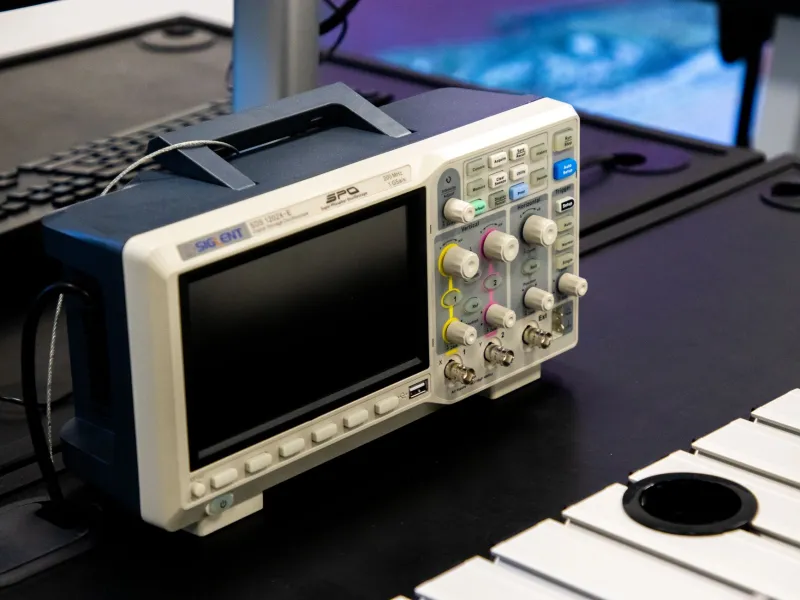
The setup was deliberately ordinary. A three-phase-capable power analyser, a calibrated shunt for low-power loads and a Rogowski coil for the rest, connected at a single socket via a short Lead. Each load was run through a settled operating period, then logged over ten-cycle windows. The analyser reports true RMS voltage and current, real power, apparent power, displacement power factor, true power factor, total harmonic distortion and crest factor. The distinction between displacement and true power factor matters. Displacement power factor describes the phase shift between the fundamental voltage and current; true power factor includes the distortion caused by non-sinusoidal current. For a resistive kettle the two are almost identical. For an LED driver they can differ by a factor of two.
Resistive loads: the easy lie
Kettles, toasters, an immersion heater and a fan heater all behaved as expected: true power factor between 0.98 and 1.00, current distortion below 5 per cent, and no meaningful inrush beyond the cold-element surge. A 3 kW kettle drew close to 3.2 kW for the first second as the element's resistance settled, then trimmed back. That is a useful reminder that a resistive load is not perfectly linear, but it is not the problem. The problem is that these loads are the ones people generalise from.
Motors and compressors: displacement by another name
The fridge-freezer compressor ran at a true power factor of 0.56, with an inrush of roughly ten times running current for 180 ms. The heat-pump tumble dryer compressor sat around 0.71. The washing machine's universal motor, under load, reached 0.78. These are displacement-dominated loads: the current lags the voltage because the motor needs magnetising current. The analyser also showed a crest factor well above 1.4, meaning the current peaks are sharper than a sine wave. For a home battery inverter rated in kilovolt-amperes, this is the relevant number. A 3 kVA inverter may happily run a 2.2 kW resistive kettle but struggle to start a 1 kW compressor whose apparent power at startup is far higher. The nameplate wattage tells you about heat; the waveform tells you about current.
Electronics without correction: the distortion factor
LED lamps were the worst offenders in distortion terms. A 6 W lamp drew a current with total harmonic distortion above 90 per cent and a true power factor of 0.48. A 30 W USB-C laptop charger measured 0.53 at half load and 0.91 at full load. A television, a games console and a mesh node all sat between 0.55 and 0.70. These are capacitively smoothed switch-mode supplies without power-factor correction, and their current arrives in narrow pulses around the voltage peaks. The result is a current waveform that is not simply shifted but reshaped. That reshaping is what makes true power factor lower than displacement power factor, and it is why a domestic load survey based only on watts will understate the RMS current in the wiring.
Heat pumps and inverters: the switching signature
The heat-pump outdoor unit's electronics measured a true power factor of 0.96, which sounds benign. The analyser's harmonic spectrum told a more nuanced story: low-order harmonics were modest, but a high-frequency ripple appeared at the inverter's switching frequency, and the current had a crest factor of 1.9. A PV inverter and a home battery inverter showed similar signatures when exporting or charging. This is not a fault; it is the nature of switched electronics. But it is a reminder that 'power factor corrected' does not mean 'sinusoidal'. For anyone co-locating equipment on the same final circuit, high-frequency ripple can travel further than expected.
Where the reactive and distorting current goes
Reactive power does not disappear; it sloshes between source and load. But the losses it causes in cables are real, because those losses depend on current squared. A load with a true power factor of 0.5 draws twice the RMS current of a resistive load at the same real power. In a single-phase home the neutral carries the same current as the line, so the effect is confined to voltage drop and cable heating. In a three-phase installation — increasingly common where a heat pump and an EV charger share a supply — triplen harmonics from single-phase electronics can add in the neutral rather than cancel. That is a commercial-building concern that is beginning to appear in domestic three-phase boards.
What this means for diverters, batteries and meters
A PV diverter measures real power at the grid connection and modulates a resistive element to absorb surplus. Its own load is close to unity power factor, so its arithmetic is sound. The difficulty arises upstream. If a home battery inverter is sized in kVA, the installer needs to know the apparent power of the loads it will back up, not just their wattage. A 5 kVA inverter may refuse to start a compressor whose apparent power at inrush is 8 kVA, even though the running load is 1 kW. Smart meters record active energy for billing, which is correct for domestic tariffs, but their instantaneous power display is not a VA meter. Comparing a meter's watt reading with an inverter app's apparent-power reading can produce a phantom discrepancy.
A sceptical note on nameplates
The nameplate kilowatt is a thermal rating, not an electrical specification. It tells you how much heat an appliance produces, not how much current it draws, how distorted that current is, or what it does in the first 200 ms after switching on. For anyone sizing a battery, a UPS, a generator or a diverter, the waveform is the specification. The practical test is simple: measure true power factor, THD and inrush at the socket, and size for the current you cannot see on the box.
The table you cannot put on a box
| Load | Real power | True PF | THD | Inrush |
|---|---|---|---|---|
| Kettle | 3.0 kW | 0.99 | 4% | 3.2 kW for 1 s |
| Fridge compressor | 90 W | 0.56 | 25% | 10× for 180 ms |
| LED lamp | 6 W | 0.48 | 92% | 40× for 1 ms |
| Laptop charger | 30 W | 0.53 | 110% | 30× for 0.5 ms |
| Heat-pump electronics | 1.8 kW | 0.96 | 12% | 2× for 20 ms |
The numbers are representative of the sample, not universal. But the pattern is consistent: the loads that look small on the box are often the ones with the least sinusoidal current. That is the shape of the problem, and it is not visible on a nameplate.