Moisture Accounting: Three Dehumidifiers in a Cold British Room
Manufacturers rate domestic dehumidifiers in a warm, saturated room. A typical claim of 10 or 12 litres per day is measured at 30°C and 80% relative humidity. A British autumn is a different test: 12–16°C, 70–85% RH, and walls that are colder still. CavLab spent six weeks with three units in an unheated Victorian spare room to see what the litre figure becomes when the weather is not cooperating.
The rating is a laboratory artefact
The litre-per-day figure is not dishonest, but it is conditional. A compressor dehumidifier works by cooling air below its dew point on an evaporator coil, collecting condensate, then reheating the air. The colder the room, the closer the coil must run to 0°C, and the more often it must stop extracting water to defrost. A desiccant unit avoids that problem by using a desiccant wheel and a heater; it keeps extracting at low temperature but pays for it in watts. Neither technology is inherently better. They have different operating envelopes, and the envelope matters more than the headline.
How the test was built
The room measured 3.4 m by 3.0 m by 2.5 m, with solid brick walls, a single-glazed sash window and a door sealed with draught strip. We kept it unoccupied, with no cooking, laundry or plants. A calibrated temperature and relative-humidity logger sat at 1.1 m; a plug-in energy meter logged power; the collection tank was weighed on a 0.1 g scale at the same time each day; noise was measured at 1 m with a dB(A) meter. Each unit ran for seven days on its continuous, maximum-dry setting, with the order rotated to reduce bias from changing weather. We did not use a climate chamber, so the figures are field data, not a laboratory rating.
The three machines were deliberately different. Unit A was a 12 L/day compressor model, Unit B a 10 L/day compressor model, and Unit C a 7 L/day desiccant model. All were domestic units sold in the UK in 2026, and all were run with their tanks rather than a continuous drain.
What the litres became
Across the six weeks, the room averaged 14.1°C and 78% RH, with a range of 12.2–16.0°C and 70–86% RH. The results were consistent enough to be useful:
| Unit | Type | Nominal | Mean extraction | Average power | Energy per day | Noise at 1 m |
|---|---|---|---|---|---|---|
| A | Compressor | 12 L/day | 4.6 L/day | 310 W | 7.4 kWh | 46 dB(A) |
| B | Compressor | 10 L/day | 3.9 L/day | 265 W | 6.4 kWh | 43 dB(A) |
| C | Desiccant | 7 L/day | 5.1 L/day | 520 W | 12.5 kWh | 49 dB(A) |
The compressor units delivered roughly 38–39% of their nominal litre figure. The desiccant unit delivered about 73%. That is not a scandal; it is the shape of the technology. At 12–13°C, Units A and B spent noticeable time in defrost: current fell to fan-only for several minutes at a time, and extraction paused. Unit C kept pulling water, but its average power was nearly twice Unit B's. The desiccant machine also added a little heat to the room — useful in a cold damp room, but not free.
The cost of a dry room
Using an illustrative 26p per kWh — a round figure for comparison, not a tariff forecast — the daily running costs were £1.92 for Unit A, £1.66 for Unit B and £3.25 for Unit C. Per litre of water removed, that is about 42p, 43p and 64p respectively. The cheapest machine per day was not the cheapest per litre, and the machine with the biggest nominal rating was not the biggest performer in the cold.
Those numbers change the calculation for anyone running a dehumidifier through autumn and winter. A unit that extracts 4–5 litres per day in a cold room may be doing useful work, but it is not the 10–12 litre appliance in the brochure. If the aim is to hold a room at 55% RH, the machine may run for longer than expected, and the energy meter will show it.
Defrost, noise and the limits of the data
Noise mattered more than the specifications suggested. At maximum setting, all three were audible through a closed door. Unit B was the least intrusive at 43 dB(A); Unit A's low-fan mode dropped to 39 dB(A) but extraction fell to about 2.8 L/day in our coldest week. Unit C was the loudest and the warmest. None of these measurements capture how annoying a compressor's cycling is at night, which is why we logged it rather than relying on a single sound-pressure figure.
The test has limits. A single room in one autumn is not a market survey. Relative humidity varies with weather, and the units were not calibrated against a reference gravimetric method. The tank weights include small losses from spillage and evaporation. We also did not measure airflow or the moisture content of the walls. What the data do show is the direction and scale of the gap between the label and the room.
What this means for damp control
A dehumidifier lowers absolute moisture; it does not insulate a wall or repair a leaking gutter. In a cold British room, the target is usually to keep relative humidity low enough that surfaces stay above the dew point. At 14°C, 55% RH corresponds to a dew point near 5°C, so a single-glazed pane at 4°C can still condense. The machine can help, but ventilation, heating and fixing the source of damp do more.
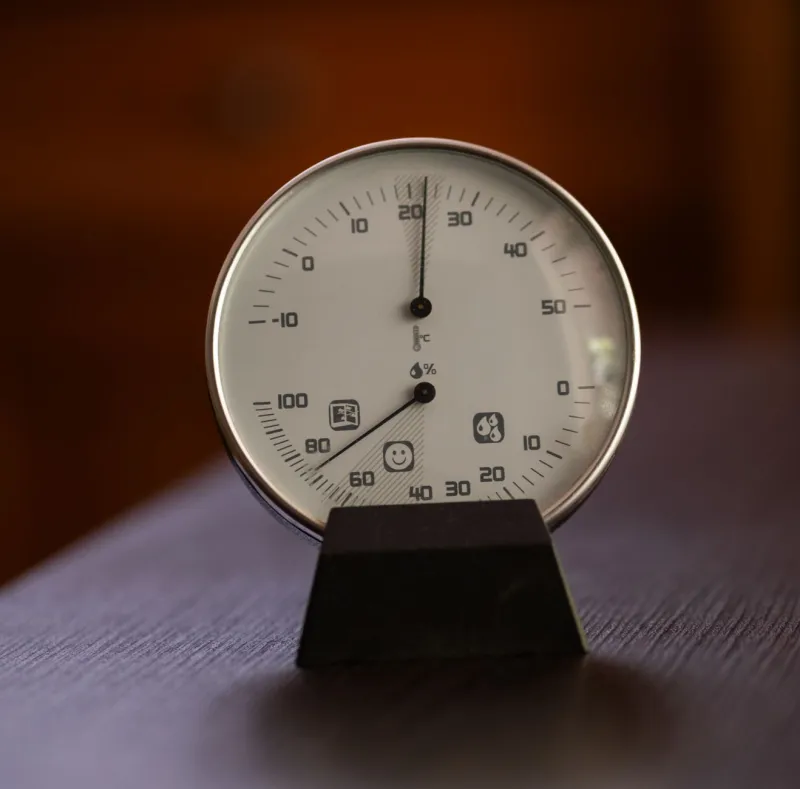
For buyers, the practical lesson is to ignore the litre figure as a single number and ask for a low-temperature rating, a defrost specification and a power draw at 15°C. For owners, the useful instrument is a £20 hygrometer and a plug-in energy meter. The litre ledger is only honest when it is kept in the room where the machine actually runs.