A Degree of Overshoot: Four Smart Thermostats, One Cold Morning, and the Limits of Boiler Control
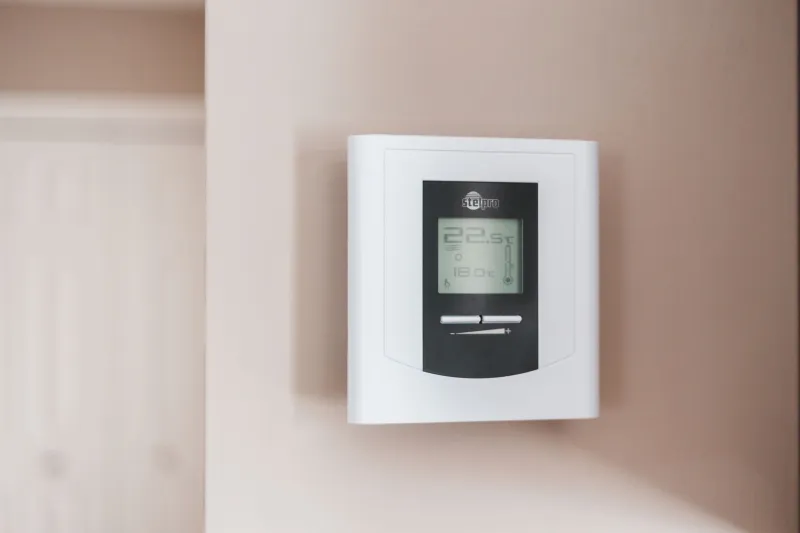
At 06:30 on a Tuesday in early November, the living room of a Victorian terrace in Sheffield was at 17.8 °C. The schedule asked for 20.0 °C. By 07:20 the thermostat on the wall was showing 21.3 °C, a calibrated logger at 1.1 m in the middle of the room was reading 20.9 °C, and the boiler was still firing. Nobody had touched anything. This is the overshoot problem, and it is worth being precise about where it comes from, because very little of it originates in the thermostat's software.
Bench First, House Second
Four mains-powered smart thermostats, costing between £90 and £220 and sold through UK trade and retail channels, were tested. They are referred to here as A to D; the point is the behaviour of a class of product, not the marketing of any one of them.
On the bench, each unit was placed in still air alongside a calibrated PT1000 probe, stepped through 15, 18, 21 and 24 °C in 20-minute stages. All four reported a steady-state value within ±0.3 K of the reference, which is creditable. What differed was the time constant. Two units applied a rolling average of roughly ten to fifteen minutes before updating the displayed number, so a genuine step change appeared on the screen between eight and nineteen minutes after the sensor had seen it. One unit displayed in 0.5 K increments, which makes a 0.2 K drift invisible rather than wrong.
The Number on the Screen Is an Estimate
A thermostat's thermistor sits inside a plastic enclosure next to a radio, a processor and, in two of these cases, a small colour display. Dissipation of half a watt to a watt inside that volume biases the reading upward by 0.2 to 0.4 K unless it is compensated. Two of the four applied a correction; two did not, and ran warm when the backlight was active.
That is before smoothing. A rolling average is a reasonable engineering choice, because it stops the displayed temperature flickering every time a door opens. It is not a measurement. When a thermostat says 20.0 °C, it is telling you what it believes the room has recently been, not what it is now. Any control decision taken on that basis is already several minutes old.
Hysteresis and the Boiler's Own Opinion
Most domestic smart thermostats still switch a boiler with a dry contact. Even those that speak OpenTherm or a manufacturer's digital protocol are constrained by the appliance at the other end. A typical 24 kW combi has a minimum modulation of about 4.5 to 6 kW. On a morning at 6 °C outside, a mid-terrace house with reasonable loft insulation may need 2.5 kW to hold 20 °C.
The boiler, at its lowest setting, is therefore delivering roughly twice the demand. It fires, the flow temperature climbs, the thermostat's hysteresis (commonly 0.3 to 0.5 K) is satisfied, the burner stops, and the water already in the circuit, perhaps 70 kg of it plus the steel of the radiators, continues to give up heat into the room for another ten to twenty minutes. That stored heat, not the thermostat, is where most of the overshoot lives.
Four Mornings, One House
Each unit was then fitted in turn to the same system: a 24 kW combi, eight radiators, no zoning, weather compensation available but disabled for the first three tests to keep the comparison honest. Setpoint 20.0 °C from 06:30, overnight setback 17.0 °C.
| Unit | Peak at logger (°C) | Peak shown on unit (°C) | Minutes above 20.5 °C | Burner cycles before 09:00 |
|---|---|---|---|---|
| A | 20.9 | 21.3 | 74 | 11 |
| B | 20.4 | 20.5 | 22 | 5 |
| C | 20.7 | 21.5 | 55 | 9 |
| D | 21.1 | 21.2 | 96 | 14 |
Unit B was the only one running the boiler over a digital protocol with load compensation, and it shows what the others cannot do: by holding flow temperature near 45 °C rather than 70 °C, the boiler modulated down instead of cycling, and the room stopped within half a degree of the setpoint. Unit D, by contrast, fired at a fixed high flow temperature and cycled fourteen times, with a peak a full kelvin above target.
What Smart Recovery Adds
Two units learned a pre-heat schedule and began firing before 06:30 to reach 20.0 °C on time. That is a comfort feature, and it works. It also means the room can arrive at setpoint before the occupant does, then sit above it while the fabric continues to release heat. On a morning when the household wakes early, or the schedule changes, the pre-heat is simply overshoot with a marketing name.
The Practical Reading
Overshoot of a kelvin for an hour is not a catastrophe. In a leaky terrace it represents perhaps 1 to 1.5 kWh of gas per morning, and it also produces the familiar complaint that the front room is too warm by the time anyone sits down in it.
The useful interventions are unglamorous. Ask whether the thermostat can modulate the boiler rather than click a relay, and whether the installer enabled load compensation or weather compensation at commissioning. Set the flow temperature to what the radiators can actually use. Fit TRVs to bedrooms and leave one radiator permanently open as a bypass. And if a precise room temperature matters, measure it separately: a £25 logger on a shelf will tell you more about the room than a display on a wall above a radiator.
The thermostat is not lying. It is estimating, smoothing, and then asking a boiler that cannot go low enough to do something it was never designed to do.